Simply Soul Searching
HOW IS GOD LOVING ME – AND WHERE IS GOD LEADING ME?
3. LET JESUS CALL US
THE ‘LET’ OF LENT – Friday, February 19th
But Jesus said to him, “Follow me, and let the dead bury their own dead.”
Matthew 8:22 (NRSV)
Then Jesus told his disciples, “If any want to become my followers,
let them deny themselves and take up their cross and follow me.
Matthew 16:24 (NRSV)
Thomas, who was called the Twin, said to his fellow disciples,
“Let us also go, that we may die with him.”
John 11:16 (NRSV)
Today we have three Bible passages in which we are invited to follow Jesus with increasing love and devotion. We are invited to let God first move us to become more spontaneous, then more selfless, and then sacrificial as we journey on with Christ. These are our spiritual invitations for today.
Let Jesus call us even when we are not ready.
In Matthew 8, Jesus has been healing people and is beginning to draw large crowds of followers. When he decides to move to the other side of the Sea of Galilee, one of those followers says, “Lord, first let me go and bury my father.” Jesus’s response to him is simply, “Follow me, and let the dead bury their own dead.”
In looking at several Bible Commentaries, I found a number of different, beautiful intentions in Jesus’s seemingly callous words. But our message for today is that we are to be about following Jesus now, about answering his call even when we do not feel ready.
Have you ever felt a nudge to do something, but thought that you needed to wait until you had the right conditions or plans in place? How many dreams or nudges have been missed because we have hesitated?
May we let God remove any reluctance that hinders us from spontaneously answering the call to follow Jesus.
Let Jesus call us even when we have other plans.
In Matthew 16, we hear Jesus’s familiar words, “let them deny themselves and take up their cross and follow me.” Now we are not just being asked to move with Jesus to the other side of the Sea. We are being called to release any of our ambitions or agendas that would keep us from letting Jesus guide us forward in faith. We are also being called to take on those things that Jesus would have us do and be.
My goal of writing a book is taking longer than I had planned, because I have been called to serve in other ways over the years. But now I see how God may be changing my purpose for the book. One day, I hope that what I write is truly what God has given me more time to discover and share.
Could you be continuing to pursue some plans that are keeping you from God’s plan? What might we set aside today? What new thing are we being called to begin?
May we let God remove any self-determination or stubbornness that would keep us from selflessly pursuing our journey with Jesus.
Let Jesus call us to perfect and complete love, more than life itself.
Finally, in John 11, we see the full fruits of devotion through the disciple, Thomas. Jesus has just told the disciples, “Let us go to Judea again” (vs. 7). Knowing that Jesus was not welcome there – that the people had even tried to stone him – the disciples question his judgment. But Jesus is determined to go, no matter the risk. And dear Thomas then says, “Let us also go, that we may die with him.”
Thomas’s sacrificial love and devotion certainly can inspire and surprise us all. And yet, when we feel a need to keep a safe distance, when we want to commit to Christ but not too much, when we are afraid of where Jesus might lead us, we can miss out on the greatest joy, purpose, and journey of our lifetimes. We may lose the most challenging, delightful, joyful, sorrowful, surprising, and meaningful life, all because we are afraid to lose our safe, controlled, planned, and predetermined one.
Will you choose the agenda, or the adventure? How might dying to ourselves bring us more fully into life?
May we let God help us to surrender our vision of a perfect life for the perfect life God envisions for us.
~~~~~
The Bible reading for Monday is Matthew 13:1-23.
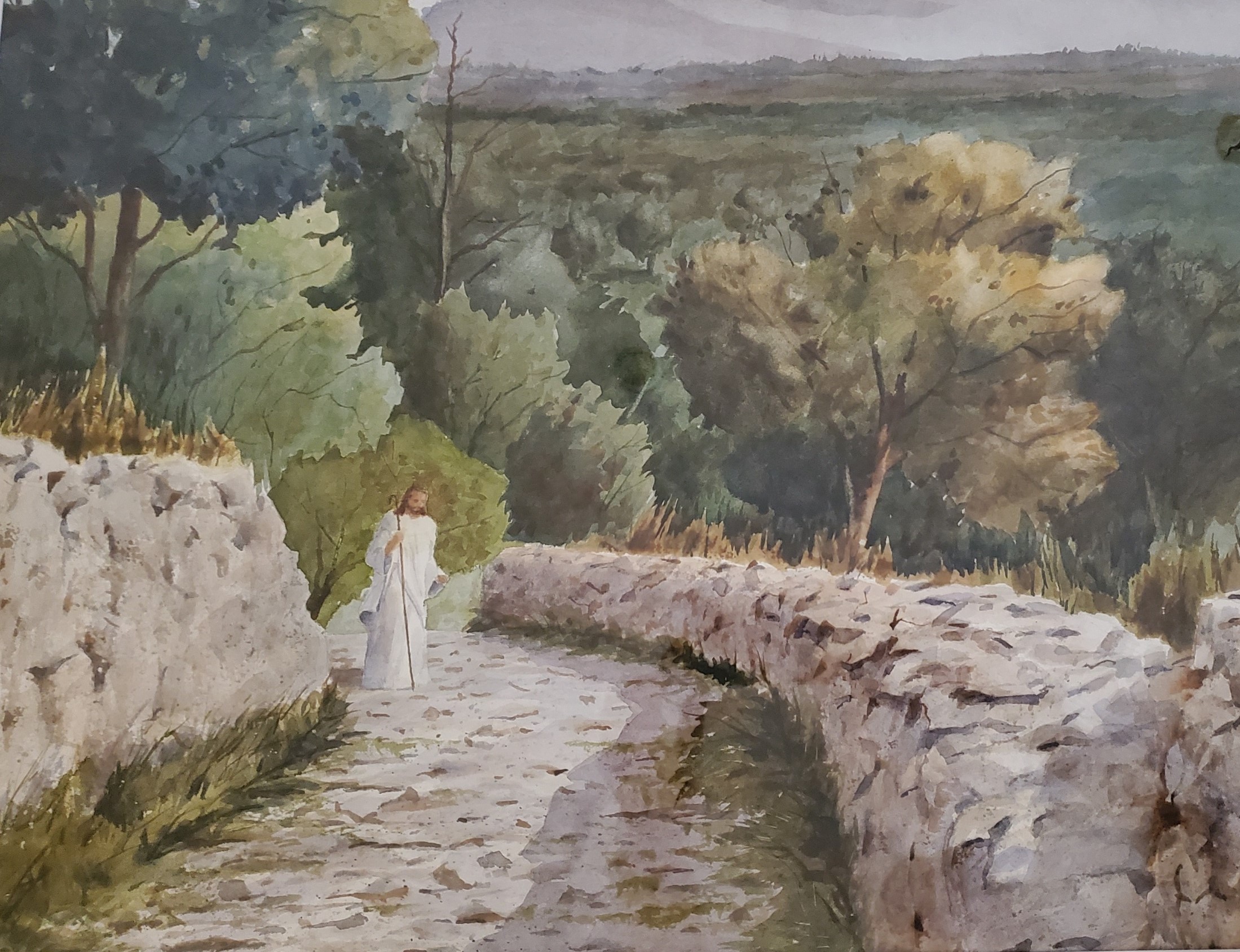
My dad painted this watercolor of Jesus on the Mount of Olives for me years ago. I love that even as I cannot see what is around the bend, Jesus is waiting for me to follow him… and I know that he will be with me all the way. (Photo by Karen.)
Bible verses are from BibleGateway.com
2. LET OUR THOUGHTS AND WORDS BE ACCEPTABLE

THE ‘LET’ OF LENT – Thursday, February 18th
Read Psalm 19.
Let the words of my mouth and the meditation of my heart be acceptable to you,
O Lord, my rock and my redeemer.
Psalm 19:14 (NRSV)
This psalm beautifully describes how God’s glorious and loving word is everywhere! The writer finds God speaking through the heavens and firmament, in the day and night, and by words, laws, and precepts. When we are listening for God, we are wise to pay attention to everything. I often find that when an inspiration comes to me, it generally comes in several ways. What begins as a word that touches my heart in a conversation, is then rediscovered in a book I am reading. Or I may notice a lesson in nature, soon followed by meaningful lyrics in a song, or an inner, quiet thought that enhances the first inspiration.
The psalmist ends his observation of God’s word found in all of creation with his plea, “Let the words of my mouth and the meditation of my heart be acceptable to you, O Lord, my rock and my redeemer.” This is our spiritual invitation for today. Our own thoughts and words should reflect God’s word, too.
How might our words and meditations become more acceptable to God?
How might we let God’s word be more clearly revealed in our words to others?
~ We pay closer attention to what God may be saying to us.
Jim and I have two toddler grandchildren who are quite articulate, but some of their words are less clear than others. As we spend more time with them, we begin to understand more of what they are saying. By observing the situations and surroundings, we can often piece together what they are trying to tell us. Sometimes I will ask them, “Show me…?” and they will take me closer to the place or item they are talking about.
In the same way, when we spend more time with God – by remaining aware of God’s constant presence with us – we begin to understand more of what God may be communicating to us. We observe our situations and surroundings for recurring themes or inspirations. We notice more of God’s presence in everything, from surprising stories to negligible nudges. If we feel unclear, we simply ask God, “Show me…?”
~ We pause before we begin to meditate or speak.
My counselor once spoke of the benefits of taking a moment to pause before speaking. This pause gives us a little extra time of awareness, a time to collect our thoughts, or put a guard on our tongue, or temper our words, or respond in love. The acronym, THINK, is a well-known checklist, but it serves as an apt reminder today. Will our words be True, Helpful, Inspiring, Necessary, and Kind?
~ We pray for God’s help.
Sometimes when I want to clarify what our toddlers are saying, I ask them, “Are you saying this to me…?” Their precious smiles confirm that I have heard correctly. We can ask the same question of God, and wait for that peaceful sense of assurance. We can also trust that the Spirit is guiding us, interceding for us, “with sighs too deep for words” (Romans 8:26). Finally, we can keep the psalmist’s prayer always in mind: “Let the words of my mouth and the meditation of my heart be acceptable to you…”
~~~~~
Let us be attentive to God’s presence this Lenten season, absorbing God’s good and perfect Word within us, so that our every word – in mind or mouth – becomes acceptable in the sight of God and reflects the light of God.
~~~~~
The Bible readings for tomorrow are Matthew 8:22, Matthew 16:24, and John 11:16.
Photo by Hannah Olinger on Unsplash
Bible verses taken from BibleGateway.com
1. LET OUR LAUGHTER BE TURNED INTO MOURNING

THE ‘LET’ OF LENT – ASH WEDNESDAY
Wednesday, February 17th
Read James 4:6-17.
Lament and mourn and weep.
Let your laughter be turned into mourning and your joy into dejection.
James 4:9 (NRSV)
Here is where our yearly Lenten journey begins: Ash Wednesday, the time we remember that “we are dust, and to dust we shall return” (Genesis 3:19). We take time to recognize how fleeting and fragile our lives are, as we confess our sins, ask for forgiveness, and try to repent of our broken ways.
Today, our spiritual practice is found in the instruction of James, to “Let your laughter be turned into mourning and your joy into dejection.” We have an opportunity to examine ourselves with honesty, humility, and remorse where needed. We grieve our sinful nature, the ways we have not lived as God would have us live. Our Ash Wednesday contemplation is often somber and sorrowful, as we recognize our desperate need for God’s perfecting and redeeming love shown in Christ Jesus.
On one unseasonably warm and sunny Ash Wednesday, I once told my pastor that we had far too nice a day to be somber and sad. He chuckled at my personal example of human nature. When life is going well, when we are feeling serene and joyful, observing Ash Wednesday can seem incongruent and maybe even unnecessary. We may be grateful to God, but how much do we need God when life is good, when we are successful and joyful and content? Why ruin an otherwise uplifting and glorious day with a serious and sorrowful examination, complete with a cross marked in gray ash on our heads?
And that is why we need Ash Wednesday. Ash Wednesday reminds us of the reason for our Lenten journey – the reason why we take these forty days to deepen as disciples, to examine our lives in the light of Jesus’s love, to change our ways, and to let God perfect us…
We long to experience the discipline of the Lenten season because we have humbly examined ourselves and know how much we need the merciful love of God. We long to draw nearer to God because we have reflected on our lives and understand how wonderful and life-changing God’s love is. We long to follow Jesus and revisit his earthly days because we have once again heard his call. We long to begin this Lenten journey because we find that we are both grateful and needy for God in Christ – through all the joy and junk of life.
My Ash Wednesday contemplation reminds me of this personal story…
Jim had cautioned me several times that I was too close to the door frame when I was backing the car out of the garage. I inwardly resented that he doubted my driving abilities. Couldn’t he see how confident and capable I was? I had come quite close to the frame numerous times but had never left a scratch! Then one day, I heard a sickening crunch as I was backing out. Inside our house, Jim also heard the noise and quickly appeared to examine the damage to the door frame, my car, and my pride.
He reacted with compassion, never saying, “I told you so.” Instead, he was genuinely and kindly more concerned about me than the damage done; he was more ready to fix what needed to be repaired and restored than how it happened. When I continued on my way, I wept both tears of shame and tears of gratitude. I am always grateful for Jim’s love, but in times like these, I am overwhelmed to be loved like this. My love for him deepens with humility, honor, gratitude, tenderness, and devotion.
Because he loves me at my worst, I want to become my best.
~~~~~
May our God of all love, compassion, and forgiveness shown in Christ Jesus draw us near, perfect our ways, and deepen our love this Lenten season.
~~~~~
Our reading for tomorrow is Psalm 19.
Photo by Clément Falize on Unsplash
Bible verses found at BibleGateway.com
THE ‘LET’ OF LENT – INTRODUCTION

Do we really LET God work in our lives?
In my Advent reflection back in December, we contemplated Mary’s words to the angel of God, “Let it be with me according to your word…” (Advent #10: Love In The Limbo). Since then, this word, LET, has remained with me, especially as I wonder how much I let God influence my heart, mind, and life. Curious, I began looking up verses in the Bible that include “let.” I was surprised to find many passages – including a variety of ways – that God can move, help, or transform us when we open ourselves to let God do so.
This Lenten season is a time to let God freely work, to let ourselves surrender to God’s goodness and guidance, and to let these forty days inspire and transform us. Each weekday during Lent, we will look at “let” verses as our inspiration for the day.
Mary’s words are a perfect introduction for our Lenten journey. As we begin any spiritual disciplines or other Lenten practices, may we be first “let it be with us according to God’s word.” May we seek to become more like the person God created us to be, according to God’s perfect will. May we long to become more like Jesus, to follow him as devoted disciples. May we find new ways to let God work in us more deeply, as we let ourselves notice and embrace all of God’s movements and moments.
May we reach the glorious Easter resurrection as newly resurrected people, fully living our new life in Christ.
~~~~~
Our passage for Ash Wednesday will be James 4:6-17.
Photo by Priscilla Du Preez on Unsplash
Just a Note…

Dear Reader Friends,
This year, the season of Lent begins on Ash Wednesday, February 17th. Until that time, I will taking a break from writing regular posts to refresh my spirit, read and reflect, update this blog site, and begin preparing daily devotions for the Lenten season. The theme will be “LENT: A SEASON TO LET…” Watch for these next month!
I also want to thank everyone who read my last series, “Moving Forward in Faith During Trying Times.” My prayer is always for you to be blessed, comforted, and inspired in some way. I generally try to write thoughts that take our focus away from our concerns about politics, social issues, and world troubles, but these have been desperate times, and I truly felt called and compelled to write what I did. This is a special thanks to those of you who at times may have found my posts uncomfortable or contrary to your heart – but have still chosen to remain with me.
Knowing the busyness of our days and the availability of numerous articles and posts to read, I regard the time you spend reading my posts as a precious gift. Thank you. You bless me more than you know.
Your friend,
Karen 🙂
(Photo by Karen)
Moving Forward: Take Heart
MOVING FORWARD IN FAITH #6
(A NEW DAY IS DAWNING)

In recent months I have found such comfort in the awareness that our United States’ system of democracy is relatively new in the scope of history. Several articles and podcasts have reminded me how our government is evolving and correcting as we go. We have certainly had our obstacles and difficulties to overcome, but we keep progressing as the issues are discovered and addressed.
Today let’s take heart. Let’s take heart that God is still working on us as individuals, as a country, and as a world. In God’s time, life itself is relatively new! We are all works in progress, and God continues to offer us guidance and correction as we go along. What a reassuring, gracious gift we have in knowing that as imperfect as we are, we are still beloved. Our mistakes and blunders can even become tools of wisdom and insight that mature and perfect us, as individuals and as citizens who share this world.
Where can we take heart today?
COVID 19: The vaccines are being distributed and eventually everyone who wants them can be protected. In the meantime, let’s keep honoring and protecting one another with masks and social distancing.
COUNTRY: Here in the United States, President Biden and Vice President Harris took their Oaths of Office this week. I found such hope and joy in the uplifting messages, the inspirational poem, and the beautiful music on Inauguration Day. Even more, the diversity of those who have been called to serve, as well as the people present – an array of different genders, races, orientations, ages, and political parties – visibly demonstrated the strength and heart of this United States. The day was a lovely reminder that my country is still a place of incredible resilience, diversity, goodness, perseverance, and hope.
CONNECTION: I believe that, at our core, most of us hold the same loving ideals, hopes, and dreams for ourselves and our world. Don’t we all hope for a world of peace, where people have enough to eat, where education helps everyone discover and achieve their dreams, where there is no more sickness or suffering or abuse or neglect, where everyone can have the health care they need, where lives are no longer cut short by gunfire or abortion, where taxes will benefit more than burden, where fear and hatred are diminished, where creation is appreciated and wisely stewarded?
We only differ on the ways and means to work toward a world like this. We are connected by much more than legislation; we are connected at the most meaningful and significant levels of goodness, generosity, kindness, and compassion. When we begin realizing the depth of our connection and the number of ideas and dreams we have in common, we have a stronger foundation from which to work together with greater understanding and cooperation.
CHRIST: Most of all, and best of all, we move forward as people with our hope in Christ. God is present here, within and among us, and we will never be abandoned. We can keep learning and growing as God’s beloved people, trusting that we are being perfected, individually and collectively, into a world of peace and joy. This journey of maturing and learning is a gift and purpose for our lives. The journey is a long one, but we are in good company. We are not alone. We have God. We have one another.
Take heart.
Philippians 1:6 (NRSV)
I am confident of this, that the one who began a good work among you will bring it to completion by the day of Jesus Christ.
Psalm 133:1 NRSV)
How very good and pleasant it is
when kindred live together in unity!
Philippians 2:2-4
If then there is any encouragement in Christ, any consolation from love, any sharing in the Spirit, any compassion and sympathy, make my joy complete: be of the same mind, having the same love, being in full accord and of one mind. Do nothing from selfish ambition or conceit, but in humility regard others as better than yourselves. Let each of you look not to your own interests, but to the interests of others.
John 16:33 (NIV)
I have told you these things, so that in me you may have peace. In this world you will have trouble. But take heart! I have overcome the world.
Photo by Jude Beck on Unsplash
Bible verses taken from BibleGateway.com: A searchable online Bible in over 150 versions and 50 languages.
Moving Forward: Take a Stand
MOVING FORWARD IN FAITH #5
(What Do You Stand For?)

A few years ago, Jim and I took our youth group on a mission trip to Newark, New York. The theme for our week of serving together was, “What Do You Stand For?” Throughout the week, we learned and experienced some ways we can stand up to love and serve God and others, as well as stand for, to represent Christ in the world, to live in a way that models Jesus.
Today as we keep Moving Forward in Faith Through Trying Times, we are invited to take a stand, to help bring about a new and better day. The issues that burden or dismay us, the beliefs or allegiances that divide us, or the heartaches that grieve us, can be turned into opportunities to DO something. Oh, we could sit and lament for hours, couldn’t we? But what good would that do our spirits or our world? How much better we are when we choose to work for good instead of lamenting the bad.
What are some ways we can stand up, by taking action through service?
What are some ways we can stand for, by representing Christ through love?
As I noted in my previous post, we cannot do it all. But we are free and encouraged to serve in the areas we are most passionate about – the issues that most bless or frustrate us – according to our character and strengths (1 Corinthians 12). Whether we have the time and energy to be an activist (use direct and public methods to bring about social and political change), or an advocate (publicly support something), provide assistance (take action to help someone or support something), or do small acts of kindness, together we can brighten and bless our community and world.*
Even in my small “corner of the world,” I see many examples of love and faith in action through my friends and family. Nancy trains assistance dogs who will help comfort and calm souls. Kay volunteers for an agency that advocates for senior citizens, helping to resolve troubles and answer their needs. Elaine helps to organize an annual trash clean-up to make her city more beautiful. Jennie marched in the Women’s March on Washington, standing together with many others for the rights of women. Angie is a dedicated foster mom, providing a safe home, tender care, and much love for children. Doy promotes the Paw Hoorah, an annual fundraising event for Planned Pethood, reducing the number of neglected or abandoned animals. Jim volunteers on the board of Fairness West Virginia, working for equal rights for those who still remain discriminated against. Several of our Toledo friends serve weekly at the Holy Trinity food pantry, not only providing food for those in need, but also praying and sharing communion with them. Denny has organized volunteers to tutor children after school. Kevin donates what he can of his meager salary to support those who work for justice and equality. These dear people are taking a stand; they are choosing to make at least one good difference for all of creation.
I find that when I act with kindness, speak for justice, or help another person – even in some small way – I am blessed with peace and joy for these difficult times. Doing so helps me to take the focus off my own troubles, gives me purpose, and adds to my own hope for better days. Each time we can transform our negative feelings into positive change, we become a blessing, but we are also blessed.
In the United States, today offers a renewed hope, with a new administration and a new president. Whatever emotions or feelings you have about the election, I hope that all Americans will regard this as an opportunity for a new beginning. There is work to do, and we are called to work for good – not only for ourselves or for our country – but also for our world.
What one thing will you do today to help make the world a better place? How might you do so with the humility and love of Jesus?
1 Corinthians 12:4-7 (NRSV)
Now there are varieties of gifts, but the same Spirit; and there are varieties of services, but the same Lord; and there are varieties of activities, but it is the same God who activates all of them in everyone. To each is given the manifestation of the Spirit for the common good.
Micah 6:8 (NRSV)
He has told you, O mortal, what is good;
and what does the Lord require of you
but to do justice, and to love kindness,
and to walk humbly with your God?
1 John 3:18 (NRSV)
Little children, let us love, not in word or speech, but in truth and action.
Photo by Nadine Shaabana on Unsplash
Bible verses found at BibleGateway.com: A searchable online Bible in over 150 versions and 50 languages.
*the definitions of activist and advocate were found at Cambridge English Dictionary: Meanings & Definitions
Moving Forward: Take Responsibility
MOVING FORWARD IN FAITH #4
(WHO’S TO BLAME?)

In his book, Essentialism, Greg McKeown writes, “Only once we discern what is absolutely essential and eliminate everything else can we make our highest contribution toward the things that really matter.”1 Let’s heed his words as we continue Moving Forward in Faith. In the heartache of this pandemic, the turmoil of economic-job losses, and the violent turbulence in politics, our world desperately needs us to make all the good differences we can – but we cannot do it all.
What are the essential things we might do? Perhaps we can first eliminate the time we may spend placing blame on others. Of course, placing blame is necessary; people who cause harm or commit illegal acts must be held responsible and culpable. Justice needs to be served. Corrections must be made. Consequences must be determined. But there are qualified people whose vocation includes doing those very things.
When we desperately want to make sense of our confusion, assign responsibility for fixing the mess, and resolve all that is wrong as quickly as possible, blaming others becomes a way to remove the burden from ourselves. We relieve ourselves of any responsibility to remedy the situation by critically assigning fault to others. We have seen numerous articles, posts, and interviews in which one person or group is blaming another, or no one, or even everyone. Rarely do we hear, “This is my fault, I am sorry, and I will make amends.” (I find this difficult to do myself!)
But, back to what is essential for us as people of faith… when we consider what is faithful and essential for us to do, what might be the more fruitful action? What might be the more loving action? What is an essential and faithful responsibility we might take on?
When an issue is angering or upsetting us, the more fruitful actions would include writing letters to our political leaders, volunteering or funding agencies that work to help with the problem, and sharing our concerns about the issues with others – providing information, raising awareness, inviting others to help – more than blaming or disparaging people.
When we are grieved or hurt by the troubles impacting us, the more loving actions might be to encourage others who are feeling the same way, to help brighten spirits with words of affirmation or hope, and to foster a spirit of forgiveness for those who have been found responsible and held accountable.
Finally, as we think about our own responsibility in making the world a better place, contemplative Franciscan Richard Rohr says, “The best criticism of the bad is the practice of the better.”2 What we wish to see in the world, we can emulate in ourselves. We can model a better way, the way of love and hope and peace and joy. If we wish for an end to both greed and poverty, we can live more generously. If we wish for more peace and unity, we can model greater acceptance and kindness. If we hope for an end to the pandemic, we can follow the medical guidelines, protect one another, and get vaccinated. Our faithful and essential responsibility could be to live and model what we hope our world will become, to let our lives be a visible example of a better way, while we refrain from criticizing or blaming those who don’t.
“Let the improvement of yourself keep you so busy that you have no time to criticize others.”
― Roy T. Bennett, The Light in the Heart
Ephesians 4:29-32 (NRSV)
Let no evil talk come out of your mouths, but only what is useful for building up, as there is need, so that your words may give grace to those who hear. And do not grieve the Holy Spirit of God, with which you were marked with a seal for the day of redemption. Put away from you all bitterness and wrath and anger and wrangling and slander, together with all malice, and be kind to one another, tenderhearted, forgiving one another, as God in Christ has forgiven you.
Romans 12:9-21 (NRSV)
Let love be genuine; hate what is evil, hold fast to what is good; love one another with mutual affection; outdo one another in showing honor. Do not lag in zeal, be ardent in spirit, serve the Lord. Rejoice in hope, be patient in suffering, persevere in prayer. Contribute to the needs of the saints; extend hospitality to strangers.
Bless those who persecute you; bless and do not curse them. Rejoice with those who rejoice, weep with those who weep. Live in harmony with one another; do not be haughty, but associate with the lowly; do not claim to be wiser than you are. Do not repay anyone evil for evil, but take thought for what is noble in the sight of all. If it is possible, so far as it depends on you, live peaceably with all. Beloved, never avenge yourselves, but leave room for the wrath of God; for it is written, “Vengeance is mine, I will repay, says the Lord.” No, “if your enemies are hungry, feed them; if they are thirsty, give them something to drink; for by doing this you will heap burning coals on their heads.” Do not be overcome by evil, but overcome evil with good.
1McKeown, Greg, Essentialism: The Disciplined Pursuit of Less. New York: Currency, 2020.
2Richard Rohr, Things Hidden: Scripture as Spirituality
Photo by Giulia May on Unsplash
Bible verses found at BibleGateway.com
Moving Forward: Take Time to Learn
MOVING FORWARD IN FAITH #3
(THERE IS USUALLY MORE TO THE STORY)

As we continue to move forward in faith during these troubling times, what are the issues or problems that most concern you? Could these issues actually be invitations to action? When we feel unsettled, tense, or curious about a problem, it may be that we are being compelled by the Spirit to make a difference.
The best way for us to begin working for good is to more fully understand the problem itself. When we take time to learn more about the issues we face, we gain a clearer picture of the reasons certain problems exist, we know more of their extent and magnitude, and we find more practical and useful ways to help. We can become better equipped and prepared for action, clear up our own misunderstandings, and mature and change ourselves – into persons of greater understanding, peacefulness, purpose, and clarity…
I didn’t vote for President Obama in 2008, but when he was elected, I optimistically thought, “Racism is now behind us!” Since then, I have witnessed the deep bigotry that persists and the racist systems that continue to be in place. I have also become aware of some ways that a bit of racism lingers in me. I grew up in a nearly all-white community, so I never had the privilege of knowing any black people until I went to college. I was also told some untruths about the black race by prejudiced adults outside my home (for example, one teacher told me that black people had to be slaves because God was punishing them for the sins of a son of Noah). Since then, I have grown in my understanding, awareness, and compassion for all who are oppressed. I recently learned more about racism – and how my childhood ignorance and misinformation affected me – when I read the book, How to Be an Antiracist, by Ibram X. Kendi. Learning more about racism gave me a deeper awareness, as well as a greater desire to work for justice.
“Read not to contradict and confute; nor to believe and take for granted;
nor to find talk and discourse; but to weigh and consider.”1
We have biased news sources and social media so readily available these days, which can make it difficult for us to discern truthful facts or to know the whole story. Our own personal biases also get in the way, as we seek out the information that affirms the beliefs we hold, while discounting the information that might make us question our stances. When we pick and choose information according to our own beliefs, we are not seeing the whole picture. One troubling example of this is when we use a Bible verse to uphold and justify what we believe, while not knowing the rest of the context, the history of the writings, the biases of the writers, the symbolism that was used, and even how the books were selected. There is so much more to the Bible’s story and message than one or two verses.
And there is more complexity to the problems in our world than one simple answer can solve. How many posts or memes have we seen or shared that seem to solve all our problems in one concise statement? (If our earthly problems had easy answers, it seems there would be no earthly problems!) Our global, national, and even personal problems are complicated, intertwined, and not easily remedied. One solution may negatively impact another issue or create a new problem. Being aware of this may help us to be more patient and gracious as we work toward solutions, and also inspire us – individually and collectively – to take the smaller steps that can lead us toward a better future.
In my prayer time recently, these thoughts about learning came to me:
Life is a constant process of learning, and no one has all the answers except for God. The most important goal for our learning should be to increase our understanding of God’s love in the world. That is, we take steps to better understand others so we might grow in unity and acceptance; learn to rethink and reframe our political and social systems to benefit all people; strive to find the best ways to care for one another and all creation; grow in our understanding of how God moves us to love; and find the deeper meanings and better purposes of this precious life we have been given.
Today, as we move forward in faith, may we open ourselves to consider new ideas, to seek out information that will change us for the better, to be more discerning in our reading and sharing, and to discover which issues may be invitations for us to learn, understand, and then find ways to resolve them.
“Always walk through life as if you have something new to learn and you will.” ~ Vernon Howard
Psalm 32:8 (NRSV)
I will instruct you and teach you the way you should go;
I will counsel you with my eye upon you.
Matthew 11:29 (NRSV)
Take my yoke upon you, and learn from me; for I am gentle and humble in heart, and you will find rest for your souls.
1Francis Bacon (English philosopher, statesman, scientist, jurist, orator, essayist, and author)
Photo by Laura Kapfer on Unsplash
Bible verses taken from BibleGateway.com: A searchable online Bible in over 150 versions and 50 languages.
Moving Forward: Take Another Look at Ourselves
MOVING FORWARD IN FAITH #2
(WHENEVER “I WOULD NEVER…”)

When my children were small, I vowed to remain patient with their questions and encourage their curiosity. I planned to regard each of their questions as an opportunity to gently explain my reasoning, teach them something new, or explain why certain rules are in place. I felt that I would be the perfect, patient mom with their many questions – until one day when my patience was worn and I answered one of those “Why?” questions with, “Because I said so!” My reply was one I had claimed I would never use. I had felt so confident in my parenting skills that I never dreamed I would use those dismissive words I had heard other parents say.
Then there was the time my friend and I were sadly discussing the grief and trials of his divorce. I confided that my marriage was challenging at times, but determinedly added, “but I would never get divorced.” He looked at me intently and then quietly said, “Never say never, Karen.” A few years later, the “never” happened. I had thought that I could handle the conflicts and trials of relationships better than other couples. But there I was…
And several years ago, Jim and I visited our daughter in West Virginia for the first time. Driving through the hills was intimidating, and I firmly stated, “I would never want to live here.” Then our health situations changed, and we decided to move to a more central location for our family. Once we became more familiar with the area, we found we actually liked the community. With additional discernment, we soon decided that Hurricane would be the best place to make our new home.
How easily I can claim that “I would never…” while believing that I would somehow know better, do better, or find better. The proclamations we announce, the judgments we render, and the bold stands we take, can be done so readily when we have not been challenged ourselves. We feel naïvely confident about our wisdom and our ability. Then patience wanes. Situations become desperate. Circumstances change. New information comes. And we find that we are no longer so sure of our once firmly-held stances or beliefs.
Certainty often arises from naiveite. We can so easily judge another’s choices or actions when they stem from circumstances or experiences we have not faced ourselves. Though I know in my heart that some actions are clearly wrong, I can imagine that in certain extreme or dire situations I would consider doing any of them. I also need to remember that my culture, family history, experience, education, and faith, do not form the definitive basis for the beliefs or actions of others. When I begin to think I have all the answers, God kindly (and at times, painfully) shows me that I certainly don’t.
Perhaps our deepest wisdom comes when we realize our lack of wisdom. Perhaps our deepest wisdom is to refrain from believing we “would never” and to stop judging others for doing so, even when they must face the consequences for their actions. Perhaps our deepest wisdom is to live each day the best we can, and remember that others are trying to do the same – under very different circumstances.
Philippians 2:1-4 (NRSV)
If then there is any encouragement in Christ, any consolation from love, any sharing in the Spirit, any compassion and sympathy, make my joy complete: be of the same mind, having the same love, being in full accord and of one mind. Do nothing from selfish ambition or conceit, but in humility regard others as better than yourselves. Let each of you look not to your own interests, but to the interests of others.
Colossians 3:12 (NRSV)
As God’s chosen ones, holy and beloved, clothe yourselves with compassion, kindness, humility, meekness, and patience.
As we move forward in faith through these very trying times, who are the people you find most difficult to understand, the easiest to judge? Today, let’s bring these people to God in prayer. Let’s ask God to increase our understanding, compassion, and humility. Let’s ask God to open our eyes to the times when we have been not only prideful, but mistaken. Finally, let’s thank God for the one certainty we do have – that we are all God’s beloved children – and from this certainty, ask God to help us find ways to make the world a kinder and better place for everyone.
(In my Introduction, I had originally planned to call this post, “Take Stock of Ourselves” but in the writing, I found this new title to be more appropriate.)
Photo by Shalone Cason on Unsplash
Bible verses found at BibleGateway.com: A searchable online Bible in over 150 versions and 50 languages.

