Simply Soul Searching
HOW IS GOD LOVING ME – AND WHERE IS GOD LEADING ME?
Maundy Thursday- Could you not stay awake with me one hour?

Could you not stay awake with me one hour?
Then Jesus went with them to a place called Gethsemane; and he said to his disciples, “Sit here while I go over there and pray.” He took with him Peter and the two sons of Zebedee, and began to be grieved and agitated. Then he said to them, “I am deeply grieved, even to death; remain here, and stay awake with me.” And going a little farther, he threw himself on the ground and prayed, “My Father, if it is possible, let this cup pass from me; yet not what I want but what you want.” Then he came to the disciples and found them sleeping; and he said to Peter, “So, could you not stay awake with me one hour? Stay awake and pray that you may not come into the time of trial; the spirit indeed is willing, but the flesh is weak.” Again he went away for the second time and prayed, “My Father, if this cannot pass unless I drink it, your will be done.” Again he came and found them sleeping, for their eyes were heavy. So leaving them again, he went away and prayed for the third time, saying the same words. Then he came to the disciples and said to them, “Are you still sleeping and taking your rest? See, the hour is at hand, and the Son of Man is betrayed into the hands of sinners. Get up, let us be going. See, my betrayer is at hand.” (Matthew 26:36-46 NRSV)
This scene at the Gethsemane really captures the desperate loneliness and abandonment Jesus must have felt as he prepared to face his horrible arrest, trial, torture and death. In his fear, grief and despair, Jesus asks God to take his cup, his fate, away… the cup isn’t taken. He asks his dearest friends to stay awake with him for one hour… they fall sleep, three times. In Jesus’ darkest hour, he feels utterly alone. He has no friends to accompany him, even to remain in prayer for him. His friends cannot comprehend his anguish.
We are heartbroken to read such words. We are quite dismayed by the disciples’ lack of effort or attention! We wonder how they could sleep during that agonizing time. We wonder how they could abandon Jesus at his time of great need, especially after all he had done for them. And then we wonder about ourselves… I wonder about myself…
~Can I stay awake even one hour?
Jesus’ life on earth showed us how God’s incarnate word is present among and within us now. We may read these Old Testament stories with a little envy, thinking that we have not been gifted with signs from God in our present time. But God IS present, active, and moving in all of creation, and in and among all of us, as God was and is in Jesus.
I think that’s where I can be asleep. I often miss the presence of God in my daily living. How often I miss the significance in the mundane. I miss the word of God as spoken through a friend. I miss the lessons of life found in nature. Or in my activity, I miss the silent whisper of the Spirit in the breeze. As Jacob once said, “Surely the Lord is in this place and I did not know it!” (Genesis 28:16). In my inattention, do I miss out on the opportunities to help, accompany, or pray with Jesus?
~How often do I abandon Jesus in his time of need?
We are so richly blessed to know that through Jesus, we are God’s beloved children. We know that nothing can separate us from the love of God in Christ (Romans 8:38-39). We know that there is nothing we can do to earn our way into heaven. We are loved and forgiven, not by our own merit, but because God IS love. So we are to live our lives in grateful obedience, out of the sheer joy of being God’s beloved children for eternity.
But I know there are times I probably count on this extravagant mercy when I could do better or do more. Because I trust that Jesus loves me SO much, I know that I will remain beloved, even when I disappoint him. I count on his forgiveness when I know I have failed him- but does his mercy in some way ‘free’ me to fail him more often? “I can’t do this for you, Jesus, but thank you for loving me anyway.” Do I become lax or lazy because I am SO loved? Each time that I do, I am abandoning Jesus in his time of need.
Are you talking to ME?
Today Jesus is asking, “Could you not stay awake with me one hour?”
Where do you notice that you have been asleep to the presence of Christ? Does Jesus’ forgiveness, mercy and love perhaps make you a little lax in your obedience? How might you have abandoned Jesus recently in his time of need? Is there a practice that will help to keep you more attentive? Today, will you especially be mindful of the agony that Jesus endured?
Could you not stay awake with me one hour?
Photo by Sander Dewerte on Unsplash (cropped by Karen)
April 8th- Do you know what I have done to you?

Do you know what I have done to you?
After he had washed their feet, had put on his robe, and had returned to the table, he said to them, “Do you know what I have done to you? You call me Teacher and Lord—and you are right, for that is what I am. So if I, your Lord and Teacher, have washed your feet, you also ought to wash one another’s feet. For I have set you an example, that you also should do as I have done to you. Very truly, I tell you, servants are not greater than their master, nor are messengers greater than the one who sent them. If you know these things, you are blessed if you do them.” (John 13:12-17 NRSV)
Years ago as part of the Maundy Thursday worship service, our pastors were going to wash our feet in a humble act of servanthood. They were doing what Jesus told us to do after he washed his disciples’ feet. I really should have seen this as a beautiful example of the way we all should follow his teaching and how we should treat one another.
But I dreaded this. I hate my feet. My toes aren’t straight and my feet are rough from miles of walking. I’m uncomfortable even going barefoot, let alone placing my feet directly under someone’s scrutiny! Before going to worship, I washed, buffed, trimmed and lathered with lotion. I hoped to make my feet at least tolerable for the poor washer.
Later I recognized how I was also trying to keep my image and ego intact.
In his gracious act of washing, Jesus demonstrates mutuality. He calls us to see one another as equals, as companions journeying together in life. Not one of us is better or greater than another. Not one of us is lesser. We learn this through the humility of being a servant- through the washing of one another’s feet. And we learn this through the humility of exposing our flaws and hidden insecurities- through allowing ourselves to be washed clean. Both are uncomfortable. Both will stretch us in ways we would rather not.
In his precious act, Jesus shows us real community. What he has done has made us equals. We love with servant love. Come as you are. Serve as you can. Be real. Be open and honest. Share your flaws. Wash one another clean. We are all in this together. We are on equal ground.
Or could we say, “We are all on equal footing?” 😀
Are you talking to ME?
Today Jesus is asking, “Do you know what I have done to you?”
Would you rather be the foot washer or the one washed clean? Why? Is there anyone you consider as lesser than you? As better than you? How might you change your perspective? In what ways are you being invited to grow today?
Do you know what I have done to you?
Photo by Matthew Wheeler on Unsplash
April 7th- But who do you say that I am?

But who do you say that I am?
Now when Jesus came into the district of Caesarea Philippi, he asked his disciples, “Who do people say that the Son of Man is?” And they said, “Some say John the Baptist, but others Elijah, and still others Jeremiah or one of the prophets.” He said to them, “But who do you say that I am?” Simon Peter answered, “You are the Messiah, the Son of the living God.” And Jesus answered him, “Blessed are you, Simon son of Jonah! For flesh and blood has not revealed this to you, but my Father in heaven. And I tell you, you are Peter, and on this rock I will build my church, and the gates of Hades will not prevail against it. I will give you the keys of the kingdom of heaven, and whatever you bind on earth will be bound in heaven, and whatever you loose on earth will be loosed in heaven.” Then he sternly ordered the disciples not to tell anyone that he was the Messiah. (Matthew 16:13-20 NRSV)
Jesus actually has two questions for the disciples. First, he asks them, “Who do people say that the Son of Man is?” and he is given a variety of answers. Then he asks the dearer question, “But who do you say that I am?” Peter names Jesus as “the Messiah, the Son of the living God.” Peter gets it right, and so Jesus commends him, even promising that because of this, he will receive the keys of the kingdom of heaven.
Long after Peter’s heartfelt profession, we have come to know Jesus as even greater than Peter could have imagined. For example, the word Messiah with the capital M means “the expected king and deliverer of the Jews.”¹ As clearly as Peter understands who Jesus is, Jesus ends up being so much more than that. He becomes an unexpected king and deliverer of all people. We have received so much more in Jesus than even Peter’s idea of a Messiah.
It’s significant that Jesus first asks, “Who do people say that the Son of Man is?” For wasn’t this our starting point of knowing Jesus? We may have learned about him from our parents, teachers, pastors, or other mentors. We learned through their sharing of Bible stories and beliefs. We learned through their experiences of him in their lives. How others described Jesus helped form our initial understanding.
But Jesus then follows up with, “But who do you say that I am?” He wants to know what he means to us; who he is, what he has become for us. We have been given a foundation of understanding, but now we are called to answer him ourselves. My understanding of Jesus continues to evolve, and I imagine this will continue for my lifetime.
Our heartfelt response to Jesus will come from our experiences of him, our relationship with him, and most of all, allowing him to reveal, teach, and inspire us with all that he is. We know Jesus best from his Spirit within us. As Jesus says of Peter’s response, “Flesh and blood have not revealed this to you.” God works in all of us to make Jesus fully known.
Jesus goes on to tell Peter that he will have the keys of the kingdom of heaven. Peter will experience Christ’s presence- kingdom living- from that moment on. Why? Because Peter has opened himself to God’s revealing work and presence in Jesus. The keys to the kingdom are given to all of us when we do the same.
Are you talking to ME?
Today Jesus asks, “But who do you say that I am?”
How would you answer him? What one word best describes what Jesus means to you? Has your understanding of Jesus changed over the years? How has your deepened relationship changed your understanding? Does your way of living and being reflect who Jesus is for others? Are you being invited to see Jesus in a new way today?
But who do you say that I am?
¹https://www.merriam-webster.com/dictionary/
Photo by Michael Dziedzic on Unsplash
April 6th- Are you able to drink the cup I am about to drink?
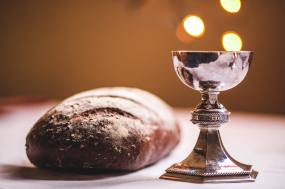
Are you able to drink the cup I am about to drink?
Then the mother of the sons of Zebedee came to him with her sons, and kneeling before him, she asked a favor of him. And he said to her, “What do you want?” She said to him, “Declare that these two sons of mine will sit, one at your right hand and one at your left, in your kingdom.” But Jesus answered, “You do not know what you are asking. Are you able to drink the cup that I am about to drink?” They said to him, “We are able.” He said to them, “You will indeed drink my cup, but to sit at my right hand and at my left, this is not mine to grant, but it is for those for whom it has been prepared by my Father.” (Matthew 20:20-23 NRSV)
Several times in the Bible, the word “cup” is used as a symbol of one’s fate. In reading a few of these verses, we see that the cup of fate includes all of life; not only its difficulties but also its joys. For example, the psalmist thanks God as his Shepherd in Psalm 23, describing his abundant blessings with the words, “my cup overflows.” However, today Jesus is referring to the dreadful portion of his cup that bears his near and awful future. This is the cup that Jesus asks God to take from him in the Garden of Gethsemane (Luke 22:42).
It’s apparent that the disciples (James and John) are only seeking the cup of victory and glory- as their mother asks to have them seated beside Jesus for eternity.* Jesus attempts to warn the two men that they don’t know what they are asking. He then asks them if they are able to drink the cup he is about to drink, which we now know as the bitter cup of false accusations, trials, torture, and death. They unknowingly assure him that yes, they are able… because they could not know what lay ahead.
None of us can know everything our cup of fate contains. We most likely hold a mixture of sweetness and bitterness in our cups, each portion revealed only as we live life, as we drink from the cup. Following Jesus will not suddenly transform the contents into all sweetness. But we can trust that Jesus accompanies us in all of the moments our cup contains. He drank a cup of bitter trials and sweet joys long before we existed, and he will help us to drink ours. Knowing we are beloved helps to make every portion of our cup more palatable. We can discern a deeper sweetness- the sweetness of the love of Christ, the sharing in his suffering- that permeates the entire cup, no matter what we encounter as we drink of it.
The difference for Jesus is that he could foresee what was going to happen to him. He saw the signs, heard the disgruntled leaders, and already had been threatened a few times. Jesus’ cup included his willingness to keep living the way God wanted him to live. Knowing what he would face, he chose to continue. Honoring God. Loving people. Helping the oppressed. Fighting injustice. Healing the sick and forgiving the sinners. Teaching a new way of living and being while proclaiming that a new kingdom had come- until the Roman leaders would end it all.
I am certain I could not have done that. Perhaps I would have tried, but I would have quickly retreated as soon as times became tough, especially if I could know what would happen to me if I continued. I would have said, “Sorry God, I tried… but it’s too hard now. I hope you understand.”
So when Jesus asks me, “Are you able to drink the cup I am about to drink?”
My answer would be… “No.”
Thank you, Jesus.
Are you talking to ME?
Today Jesus is asking, “Are you able to drink the cup that I am about to drink?”
Is there a portion of your cup that you currently do not want to drink? What is a recent sweetness you have enjoyed? A recent bitterness you have endured? In these trying times, does it help to know that Jesus helps you with every drop your cup contains? How does Jesus make your cup better? Would you be able to drink the cup that Jesus drank? How might you thank him today?
Are you able to drink the cup that I am about to drink?
*In Mark’s gospel, James and John ask Jesus themselves (Mark 10:37).
Photo by James Coleman on Unsplash
Palm Sunday- Have I been with you all this time…?

Have I been with you all this time… and you still do not know me?
“Do not let your hearts be troubled. Believe in God, believe also in me. In my Father’s house there are many dwelling places. If it were not so, would I have told you that I go to prepare a place for you? And if I go and prepare a place for you, I will come again and will take you to myself, so that where I am, there you may be also. And you know the way to the place where I am going.” Thomas said to him, “Lord, we do not know where you are going. How can we know the way?” Jesus said to him, “I am the way, and the truth, and the life. No one comes to the Father except through me. If you know me, you will know my Father also. From now on you do know him and have seen him.”
Philip said to him, “Lord, show us the Father, and we will be satisfied.” Jesus said to him, “Have I been with you all this time, Philip, and you still do not know me? Whoever has seen me has seen the Father. How can you say, ‘Show us the Father’? Do you not believe that I am in the Father and the Father is in me? The words that I say to you I do not speak on my own; but the Father who dwells in me does his works. Believe me that I am in the Father and the Father is in me; but if you do not, then believe me because of the works themselves. Very truly, I tell you, the one who believes in me will also do the works that I do and, in fact, will do greater works than these, because I am going to the Father. I will do whatever you ask in my name, so that the Father may be glorified in the Son. If in my name you ask me for anything, I will do it.” (John 14:1-14 NRSV)
Aren’t the words of Jesus so comforting, so inspiring, and so touching, especially as we know what is ahead for him? I have included the whole passage for your reflection on this Palm Sunday. This is not the typical passage we would read today, but Jesus’ question is very appropriate. “Have I been with you all this time… and you still do not know me?”
As the people gathered to praise Jesus during his seemingly triumphant entry into Jerusalem, they were praising him as the One who would be their Savior, their Messiah who had come to save them from Roman oppression. They had no way of knowing who he really was… the way he really had come to save them. So, as their praises rang out, as their palm branches waved, Jesus could have asked them as well: “Have I been with you all this time… and you still do not know me?”
Today his question is for us. How do we “still not know” Jesus?
Let’s consider the ways our friendships deepen. What begins as a brief encounter or introduction evolves into friendship as we learn more about each other. We grow to know and understand each other in a deeper way from sharing more of life together. Eventually we enjoy a mutual give-and-take in our relationship that blesses us both. But the closest friends- the ones we know and love deeply- are the ones in whom we can be fully transparent, the ones with whom we have shared challenges as well as victories, the ones we trust to share our inner insecurities and anxieties, and the ones we count on to provide insight, guidance and perspective- all with unwavering love.
Could it be that we will come to know Jesus better by “allowing” him to know us better? With Jesus, do we attempt to put on a first impression instead of an honest and deep sharing of our souls? Will our friendship and love for Jesus deepen as we become more truthful and open with him- even about our failures, insecurities, and anxieties? Will our trust increase as we learn to entrust him with everything?
The truth is, Jesus already knows us completely. But as we increasingly open ourselves to him, Jesus will increasingly be able to reveal himself to us.
Jesus knows God because God dwells in him. Their relationship is that close. “I am in the Father and the Father is in me.” We can know Jesus because his Spirit dwells in us. Our relationship can be that close. But we must do the necessary work of real relationships.
This week, we have an invitation to deepen our relationship with Jesus. We will walk with Jesus through this Holy Week, to the table, to Gethsemane, to the cross, to the tomb. We will listen to his words, experience his trials, share our hearts, and follow his path of love. Along the way, let’s open ourselves to him in honesty, confession, trust, humility, joy, and love. As we journey together, may we all come to know him better and to love him more completely.
Are you talking to ME?
Today Jesus is asking, “Have I been with you all this time… and you still do not know me?”
How will you make this Holy Week a time to know Jesus more completely? To know yourself more completely? How will you make this Holy Week a time to love Jesus more deeply? To love yourself more deeply?
Have I been with you all this time… and you still do not know me?
Photo by Levi Hernández on Unsplash
Preface to Holy Week (and Readings)
Tomorrow we will enter into Holy Week.
I have been richly blessed in recent years to have learned from such spiritual contemplatives as Richard Rohr, Philip Gulley and Rob Bell. One new perspective that truly has helped me, is the insight that God is complete love, and Jesus is God’s love incarnate in our world. I’d like to share how that has changed my perspective and my life before we enter Holy Week.
In my younger years, I learned that Jesus died as a sacrifice for our sins. This led me to understand God’s love as conditional, that God wouldn’t have loved us unless God’s very son died. We can have trouble grasping that God is complete love. Some of this stems from biblical writers who described God as a punitive God. The people of that time saw calamity and disaster as God’s wrath upon their sinfulness. They understood the practice of offering sacrifices as a way to appease God.
Jesus wasn’t sent to be a sacrifice for our sins to placate God. Nor did he take our sins upon him in his crucifixion. Instead, Jesus came as God’s incarnate Word; God’s actual living presence in our world that continues today. The Roman government and religious leaders saw Jesus’ radical way of living and loving as a threat, especially as people began to hail him as their Messiah. And so they killed him. We would have, too.
When we say that Jesus followed God’s will all the way to the cross, we can misunderstand. God’s will was not the death of Jesus. God’s will is for us to live in love, to serve one another, to share the world in peace and generosity, to honor and thank God for all of creation. This is how Jesus followed God’s will- he continued to live the way God had called him to live, never retreating, never giving up, never denying, until he died.
God is love. TOTAL LOVE. God does not punish. We encounter troubles of our own creation when we do not live in love, in generosity, in freedom, in forgiveness, in justice and peace. I am so thankful to understand this. Thank you, Richard, Philip, Rob, and all others who helped me see God’s love and Jesus’ life in a new and transformational way.
May my life reflect your love, always, in the world, dear God.
~~~~~~~~~~~~~~~
Here are the readings for the rest of these Lenten and Easter meditations.
Palm Sunday, April 5- John 14:1-14
Monday, April 6- Matthew 20:20-23
Tuesday, April 7- Matthew 16:13-20
Wednesday, April 8- John 13:12-17
Maundy Thursday, April 9- Matthew 26:36-46
Good Friday, April 10- Matthew 16:21, 24-26
Easter Vigil, Saturday, April 11- Luke 18:1-8
Easter Sunday, April 12- John 21:15-17
Monday, April 13- Luke 24:13-27
Tuesday, April 14- Luke 24:36-43
May God bless you in this precious week ahead.
April 4th- Why do you trouble the woman?

Why do you trouble the woman?
Now while Jesus was at Bethany in the house of Simon the leper, a woman came to him with an alabaster jar of very costly ointment, and she poured it on his head as he sat at the table. But when the disciples saw it, they were angry and said, “Why this waste? For this ointment could have been sold for a large sum, and the money given to the poor.” But Jesus, aware of this, said to them, “Why do you trouble the woman? She has performed a good service for me. For you always have the poor with you, but you will not always have me. By pouring this ointment on my body she has prepared me for burial. Truly I tell you, wherever this good news is proclaimed in the whole world, what she has done will be told in remembrance of her.” (Matthew 26:6-13)
In this meaningful gesture, a woman (John’s gospel identifies her as Mary) graciously and generously anoints Jesus with a jar of costly ointment. Her act is an act of adoration and care. Her act is also reverent and holy. Most of all, her act is rich with symbolism and foreshadowing, as Jesus soon points out. She is preparing him for his upcoming burial.
Observing all of this, do the disciples commend, honor and praise her for this significant and meaningful act? No. They accuse her of being wasteful- and even shameful- because she did not sell the perfume and use the money to help the poor. Jesus then asks them, “Why do you trouble the woman?”
Oh my goodness, how often could Jesus ask us this question? How often have we misinterpreted someone’s actions and assumed the worst? What we see is always only part of the whole picture. We often do not know details that would significantly affect our understanding. We then may have a tendency to judge a questionable act unfairly or negatively, instead of choosing to see it in the best light. We should try to remain aware that we don’t always know the full truth.
One area I must turn from is assigning intention. This is when I say such things as, “She’s only doing that because…” “He doesn’t really mean what he says…” “I don’t know why her parents would allow her to…” Instead of granting the benefit of the doubt, I can easily jump to my own critical conclusions.
There is one more lesson for us here. If the disciples had known how short their time with Jesus would be, they would have joined the woman. Up to the very end, they tried to deny that there would be a burial. Our time with one another is precious, too. We have better things to do in this short time together than to criticize and complain about one another!
Are you talking to ME?
Today Jesus is asking, “Why do you trouble the woman?”
Can you recall a time when you made an incorrect assumption of someone? Has another person misjudged your actions? What did you learn from these moments? In what ways does Jesus give you new perspectives on what is important? In this precious and short time together, how might you regard others as sacred? How might you remember to shine the best light on a situation?
Why do you trouble the woman?
Photo by Clem Onojeghuo on Unsplash
April 3rd- If I have told you about earthly things and you do not believe…?

If I have told you about earthly things and you do not believe, how can you believe if I tell you about heavenly things?
Nicodemus said to him, “How can these things be?” Jesus answered him, “Are you a teacher of Israel, and yet you do not understand these things? “Very truly, I tell you, we speak of what we know and testify to what we have seen; yet you do not receive our testimony. If I have told you about earthly things and you do not believe, how can you believe if I tell you about heavenly things? No one has ascended into heaven except the one who descended from heaven, the Son of Man. And just as Moses lifted up the serpent in the wilderness, so must the Son of Man be lifted up, that whoever believes in him may have eternal life. (John 3:9-15 NRSV))
You may remember how Nicodemus came to Jesus at night, most likely so that he would not be seen. Nicodemus is curious, intrigued by Jesus, and he wants to learn more. Jesus tries to explain his purpose of salvation, the work of the Spirit and other “heavenly things.” He uses such phrases as “born from above” and “the wind blows where it chooses” to help clarify what he means. Wise Nicodemus still cannot understand. This is when Jesus asks our question for today. “If I have told you about earthly things and you do not believe, how can you believe if I tell you about heavenly things?”
As we grow in faith, as we deepen in our relationship with God, our understanding of the heavenly kingdom gradually reveals itself more clearly. Jesus, the Son of Man, came to reveal this kingdom to us through his life, death and resurrection. The Word has been made flesh, and the Word is present in everything within and around us. As Jesus tells Nicodemus, being born of the Spirit opens up a new way of seeing these things.
Christ (as God’s presence) is also naturally part of God’s creation, making all of creation sacred and holy. How fitting then, that Jesus often used earthly things and earthly examples to teach us about kingdom living and presence. Jesus spoke of mustard seeds, fig trees, soil, salt, stones, birds, wheat, lilies. As we keep seeking the kingdom of God, we would be wise to look to nature and creation, asking the Spirit to reveal what they have to teach us, too.
We are just beginning to see all of the wonders that await us! How incredibly awesome and beyond our comprehension our God is!
Are you talking to ME?
Today Jesus is asking, “If I have told you about earthly things and you do not believe, how can you believe if I tell you about heavenly things?”
How do you best see God’s presence (Christ) in the world? Have you caught glimpses of the kingdom of God? What were they? How might you open yourself to greater awareness of this sacred and holy creation, these movements of the Spirit, this present heavenly kingdom? Does this passage give you a new sense of wonder and awe?
If I have told you about earthly things and you do not believe, how can you believe if I tell you about heavenly things?
Photo by mosi knife on Unsplash
April 2nd- What did you go out into the wilderness to look at…?

What did you go out into the wilderness to look at? What then did you go out to see?
As they went away, Jesus began to speak to the crowds about John: “What did you go out into the wilderness to look at? A reed shaken by the wind? What then did you go out to see? Someone dressed in soft robes? Look, those who wear soft robes are in royal palaces. What then did you go out to see? A prophet? Yes, I tell you, and more than a prophet. This is the one about whom it is written, ‘See, I am sending my messenger ahead of you, who will prepare your way before you.’ Truly I tell you, among those born of women no one has arisen greater than John the Baptist; yet the least in the kingdom of heaven is greater than he. (Matthew 11:7-11 NRSV)
In earlier passages, we learn that John (the Baptist) was in prison, wondering if Jesus was truly “the one who is to come.” So Jesus sent his disciples to tell John about their incredible experiences with him, so John would indeed know that Jesus IS the One. Now, in our passage for today, Jesus is praising John before the crowds, enlightening them of the magnitude of John’s role- for him and for them. John the Baptist is more than a prophet, he is the messenger who prepared the way for Jesus.
Jesus asks his questions of the crowd. “What did you go out into the wilderness to look at? What then did you go out to see?” John certainly wasn’t the type of prophet the people expected. John was a most unusual messenger who prepared the way for their Messiah- the one who would come to save them. He was rough and stern. He wore camel hair and ate locusts. John did not wear soft, royal robes; John was not born in a palace. He was a totally unexpected prophet for the people.
The people would soon discover that Jesus was a totally unexpected savior, as well.
~~~~~~~~~
We recall that Jesus went into the wilderness after he was baptized by John, in order to face temptations and ready himself for the life of complete obedience to God. Since then, people are often drawn to the desert as a place of spiritual deepening. In the barrenness of the wilderness, most distractions are removed and all comforts and company are gone. In the emptiness and solitude, people often find deeper meaning, greater awareness, and new life through a more clearly revealed presence of God.
We will soon enter Holy Week. Today, let’s imagine we are heading to the wilderness. We are entering a place of barrenness, with the fervent hope of sensing God’s presence more fully. Jesus’ questions are directed to us, to guide our thoughts and emotions.
Are you talking to ME?
Today Jesus is asking, “What did you go out into the wilderness to look at? What then did you go out to see?”
What is your spirit hoping to find in the week ahead? If all distractions were removed, what might God reveal to you? What would you see? Can you release all expectations? Can you prepare to be surprised? Left alone with the Spirit, what do you hope will happen?
What did you go out into the wilderness to look at? What then did you go out to see?
Photo by Andrew DesLauriers on Unsplash
April 1st- Who set me to be a judge or arbitrator over you?

(This meditation was written back in February, but it takes on deeper significance today. This pandemic is challenging our world in so many ways- and we need the eternal and relevant wisdom of Jesus more than ever.)
Friend, who set me to be a judge or arbitrator over you?
Someone in the crowd said to him, “Teacher, tell my brother to divide the family inheritance with me.” But he said to him, “Friend, who set me to be a judge or arbitrator over you?” And he said to them, “Take care! Be on your guard against all kinds of greed; for one’s life does not consist in the abundance of possessions.” Then he told them a parable: “The land of a rich man produced abundantly. And he thought to himself, ‘What should I do, for I have no place to store my crops?’ Then he said, ‘I will do this: I will pull down my barns and build larger ones, and there I will store all my grain and my goods. And I will say to my soul, Soul, you have ample goods laid up for many years; relax, eat, drink, be merry.’ But God said to him, ‘You fool! This very night your life is being demanded of you. And the things you have prepared, whose will they be?’ So it is with those who store up treasures for themselves but are not rich toward God.” (Luke 12:13-21 NRSV)
Jesus has several good lessons for us in today’s passage, doesn’t he?
“…one’s life does not consist in the abundance of possessions.”
After our illnesses and before our move to West Virginia, Jim and I gave away many of our possessions. We moved into a smaller home, and there we discovered a new freedom and joy with our lack of clutter and simpler way of living. However, since that time we have started “collecting” again. We may be more mindful of our purchases these days, but I recently ordered a new set of shelves… to display more possessions…
I needed to be reminded of Jesus’ words. Someone once said that if we think we aren’t attached to our possessions, why do we worry about leaving the garage door open or the door unlocked when we leave home?
“So it is with those who store up treasures for themselves but are not rich toward God.”
How might we live according to this beautiful phrase, rich toward God? What would a life that is rich toward God look like? We would pay more attention to our relationships than possessions. We would have more time to spend with loved ones, to appreciate nature, to commune with God. We would live with a spirit of generosity, an abiding trust in God’s provision, and a deeper gratitude for all the blessings we have been given. No barns or storehouses can hold these precious gifts found in the life that is rich toward God.
“Friend, who set me to be a judge or an arbitrator over you?”
This question is so pertinent for us today. Jesus doesn’t come to us as an arbitrator, to decide or divide for us. If we are called to share all of creation with one another, we shouldn’t even have these issues. If we are not to store earthly treasures, we shouldn’t argue over inheritances. Jesus gave us his all, and he calls us to a new way of living and sharing the world. Arbitration would be a waste of his time- and ours.
Jesus sees our faults but also our goodness, he understands our pettiness and appreciates our selflessness, he knows our tendencies to be selfish or greedy, and he encourages us to live differently.
Jesus doesn’t want to arbitrate. Jesus wants us to share.
Jesus doesn’t want to judge. Jesus wants us to forgive, bless and love one another.
Are you talking to ME?
Today Jesus is asking, “Friend, who set me to be a judge or arbitrator over you?”
Have you ever argued over an inheritance or possession? Does the pursuit of earthly treasures consume much of your time? Are there relationship issues you wish Jesus would decide for you? How might you grow in the freedom of generosity today- both in possessions and in lovingkindness? How does this pandemic give you new perspectives about what is important in life?
Friend, who set me to be a judge or arbitrator over you?
Photo by Wonderlane on Unsplash
 Simply Soul Searching