Simply Soul Searching
HOW IS GOD LOVING ME – AND WHERE IS GOD LEADING ME?
Tuesday, March 28th- Obedience
James 1:22-25 (NRSV)
22 But be doers of the word, and not merely hearers who deceive themselves. 23 For if any are hearers of the word and not doers, they are like those who look at themselves in a mirror; 24 for they look at themselves and, on going away, immediately forget what they were like. 25 But those who look into the perfect law, the law of liberty, and persevere, being not hearers who forget but doers who act—they will be blessed in their doing.
When we moved into our new home, I was determined to be the NEW Karen. I was going to have all of our belongings in appropriate places, purposefully organized and efficiently arranged. The keys would be in a basket near the garage door. All of our kitchen utensils would be stored for easy access at the proper food preparation area. I took some time to unpack as I considered the best places to place our items. Life would run so smoothly!
But I keep forgetting where these organized, efficient places are! Out of habit, I return to the old places we used to keep our belongings. I’m taking lots of extra steps to find my keys, or utensils, or other items. My efficiency is hindered by my old habits, my usual ways of doing things. I forget how to go about this new way of living. NEW Karen has largely reverted back to usual Karen.
Our Lenten practice for today is obedience. The writer of James is correct- we need to be doers of the word. So many times a sermon message or Bible reading has inspired me to change my ways or take steps to make a difference. But by the next Sunday, I’ve often forgotten what moved me the week before. Because I didn’t follow up my inspiration with action, I was unable to even recall the lesson I’d learned, the nudge I should have acted upon. Life had remained the usual life.
Today let’s try to obediently respond to what we notice or hear. If we feel a nudge or an inspiration from God, let’s make that change or take that step. The more we practice responding to God’s word, the more we will understand and remember what God is teaching and showing us. We will be less likely to forget the new way God is calling us to live. In fact, with enough follow-through, our new way of living may become a habit!
“Prayer will become effective when we stop using it as a substitute for obedience.” A. W. Tozer
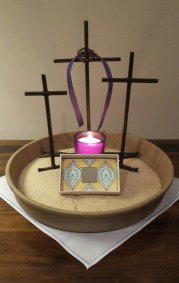
Our symbol is a mirror. May it remind us of these words from the book of James. May we hear what God is teaching us, see what God is showing us, sense how God is nudging us, and then wholly, immediately, and obediently take action to do them.
Inspiring, moving, teaching God,
You are revealing new ways to live and to be. Reveal them to me.
You are calling me to listen and obey. Show me the way.
You are inviting me to love like you. Move me to DO.
Amen.
Monday, March 27th- Justice

Micah 6:8
He has told you, O mortal, what is good;
and what does the Lord require of you
but to do justice, and to love kindness,
and to walk humbly with your God?
I was a young mom, heading to the check-out lines at the grocery store. A kind cashier invited me to the “express check-out” lane. I didn’t have many groceries, but I explained that I needed to write a check (checks were not allowed on those lanes at that time). He encouraged me to come anyway, and I was grateful. I had been feeling blue about my recent miscarriage, and it was nice to be treated with this kindness.
Another shopper arrived as I was writing my check and probably assumed I wasn’t following the rules. He impatiently kept pushing his cart into my side as if to hurry me along. I wanted to tell him what had happened but I couldn’t speak… I knew I would cry. I felt so vulnerable, as I was overcome with embarrassment, grief and an inability to defend myself. I wished the cashier would have noticed what the angry man was doing and explained the situation to him.
Our Lenten practice for today is justice. Our calling as followers of Christ is to work to make things right for people who can’t. My incident was minor, but it serves as an example of how we might help others who suffer great injustices and who desperately need our help.
Justice begins when we refrain from jumping to conclusions but instead take the time to learn someone’s story. Or at least to give them the benefit of kindness when we don’t understand their actions. Things may not be what they seem. There is always another story behind the one we see before us.
Justice is practiced when we learn to speak for those who are vulnerable, who are unable to speak for themselves. I remember standing aside when another classmate was treated badly. I regret the many times I have listened to gossip- or even joined in-when I should have been speaking up and defending. I wasn’t the instigator, but I was still part of the problem. In the 1700s, the Irish statesman Edmund Burke said, “The only thing necessary for the triumph of evil is for good men to do nothing.”
Justice is lived when we become vulnerable ourselves. To be willing to stand with those who need us, help others even if we put ourselves in jeopardy, open ourselves to criticism for speaking hard truths, and challenge others to rethink the social systems that lead to injustice and inequality. After the Pulse shooting, Jim and I were a little nervous about attending a Pride parade in Columbus. But we knew that our vulnerability was nothing like the injustice and vulnerability that our dear son, brother, and many loved ones face, every single day. We knew our vulnerability was nothing like the vulnerability our daughter faced as she marched IN the parade. While we make ourselves exposed and vulnerable, we learn to trust that God’s love is covering us, no matter what.
What does God require of us but to do justice- To love kindness- And to walk humbly with our God?
Our symbol for today is a pitcher of water, from Amos 5:24 (NRSV): Let justice roll down like waters, and righteousness like an ever-flowing stream. If you have a small fountain, this would be ideal! May the water inspire us to keep clearing any obstacles that prevent justice and righteousness from flowing freely.

God of ALL,
You call me to do justice. Help me not to remain silent or idle, but to courageously speak or stand for those who are unable to defend themselves.
You call me to love kindness. Help me not to assume or judge, but to look with kindness on people or situations I may not understand.
You call me to walk humbly with you. Help me not to be self-protecting, but to feel your presence as I walk with those who are vulnerable and marginalized.
May I move as your river of love where streams of justice and righteousness flow.
Amen.
Saturday, March 25th- Simplicity

Luke 10:41-42
41 But the Lord answered her, “Martha, Martha, you are worried and distracted by many things; 42 there is need of only one thing. Mary has chosen the better part, which will not be taken away from her.”
When we moved from our home to a small apartment, Jim and I reduced our belongings and furniture. We did this out of necessity, and we also wanted to simplify and live more minimally. But now that we have moved to our new home, I find I am excited about new decorations and furniture. (“Wouldn’t this look nice in that corner?”) I realize that I enjoy having a cozy home, with interesting items that inspire or brighten our days, with comfortable spaces to offer our hospitality to others.
Today our Lenten practice is simplicity. Perhaps the genuine spiritual practice of simplicity is what Jesus is referring to in his words to Martha, “there is need of only one thing. Mary has chosen the better part…” Simplicity can be practiced or lived out in a variety of ways, but all of these ways are to help us live with one purpose: loving God wholeheartedly. The simplicity is in having this one purpose in life! When we have one purpose, a singleness of heart, our single heart is our whole heart.
For our simplicity focus today, let’s consider ridding ourselves of those things that keep our hearts from loving God wholeheartedly. Our clutter might be closets stuffed with material possessions. But our clutter could also be schedules jammed with activities and work, minds jumbled with worry or unnecessary concerns, or hearts filled with resentments or pettiness. One small step at a time, we can keep removing the clutter that impedes our purpose of loving God.
Let’s also remember to keep those things that help us to love God wholeheartedly. How might we keep our homes in ways that bring joy to us and bless others, keep spaces in our schedules for time with God, keep God’s words and love in our hearts, or keep God’s peace and hope in our souls? We may discover new, delightful ways to live in simplicity; to live with a singleness of purpose, our wholehearted love of God.
Our reminder symbol is any item that is meaningful to us. (Mine is a small cross from my friend, Nancy, that reads, “live simply.”) May it remind us to be discerning about what distracts and impedes us from loving God, and what inspires and helps us to love God.

Loving God,
You love us with infinite love. Even as I long to love you completely, I know that so many things pull my heart in different directions- and away from loving you wholeheartedly. Help me to find new ways to live in simplicity. Help me to live with a single purpose, that of loving you. Amen.
Friday, March 24th- Newness

Romans 6:4
Therefore we have been buried with him by baptism into death, so that, just as Christ was raised from the dead by the glory of the Father, so we too might walk in newness of life.
Here in the northern hemisphere, spring has come! There is something especially glorious about the blossoms and greenings after barren winters. All around us, we see new life, new colors, and new beauty ‘springing’ forth! All of nature seems to speak to us of resurrection and new life after being buried under the cold and snow of winter.
And so our Lenten focus for today is newness. 2 Corinthians tells us, “So if anyone is in Christ, there is a new creation: everything old has passed away; see, everything has become new” (2 Corinthians 5:17, NRSV). In Christ, we are made completely new! But how might we live out this newness we have in Christ?
My Word Thesaurus describes newness as novelty, innovation, originality, freshness, inventiveness, and individuality. If we take a look around, we see that each of us is made uniquely. And Paul affirms that we have received a variety of distinct gifts in which we can serve one another (1 Corinthians 12:4). I am an original work of God. You are a fresh, innovative creation of God. We are all novelties with individuality. This is pretty exciting news! Think of all of the years and people it took for God to create each of us. Incredible.
Our verse today emphasizes another important aspect of this newness we have: “Therefore we have been buried with him by baptism into death.” In the gift of baptism, our old selves died- including all of our sins, regrets, oversights, and imperfections. But this also means that we died to ourselves. This new life doesn’t belong to us; this new life is to be used as God would like us to use it. So here are the questions we might ponder:
What does God see in us that we have yet to discover and share with the world? In what fresh, new way may God be calling us to use our unique gifts and passions? Is there anything inside of us that has been buried under doubt, fear, busyness, or selfishness?
What will we reveal as our new way of living and walking in this world? What new fresh aspect of ourselves, as God’s beautiful creations, will we share with others?
Our symbol for today is your photo. May the photo remind you that God has made you beautifully and originally. Life gives us the opportunity to share our uniqueness and our individual gifts in loving service to God. In what fresh new way could we open ourselves to be used by God today?

Our prayer is a beautiful one I found on the internet, but I’m unable to determine the original writer.
God, please enlighten my mind with truth.
Inflame my heart with love.
Inspire my will with courage.
Enrich my life with service.
Pardon what I have been.
Sanctify what I am.
And order what I shall be.
Amen.
Thursday, March 23rd- Goodwill
Matthew 7:1-5
“Do not judge, so that you may not be judged. 2 For with the judgment you make you will be judged, and the measure you give will be the measure you get. 3 Why do you see the speck in your neighbor’s eye, but do not notice the log in your own eye? 4 Or how can you say to your neighbor, ‘Let me take the speck out of your eye,’ while the log is in your own eye? 5 You hypocrite, first take the log out of your own eye, and then you will see clearly to take the speck out of your neighbor’s eye.
I must admit that when I read this passage, I sometimes wonder (with a little resentment) why Jesus didn’t say, “Why do you see the speck in your neighbor’s eye, but do not notice the speck in your own eye?” Why does MY eye have the log? Why can’t we both just have specks?
And that’s what this passage is all about, isn’t it? Jesus is teaching about not judging, and I start to whine that my flaws shouldn’t be any worse than anyone else’s. As soon as I begin comparing specks, Jesus’ words about judgment are clearly spoken for me!
Today our Lenten practice is goodwill. Goodwill includes kindness, benevolence, concern, and generosity. If we treat others with goodwill, we treat any flaws we may notice with mercy, understanding and compassion. We are aware that we have the same flaws. And- I’m learning- that we even have worse flaws!
Perhaps we lack goodwill especially when we are driving. Why do we tend to judge those who make mistakes with less goodwill than we do for ourselves? We may judge other drivers with descriptive words such as “aggressive,” “ignorant,” “impatient,” and “reckless.” But our own mistakes are “innocent,” “unavoidable,” “rare,” and “understandable.” It is so easy to treat ourselves more benevolently than the stranger in the other car.
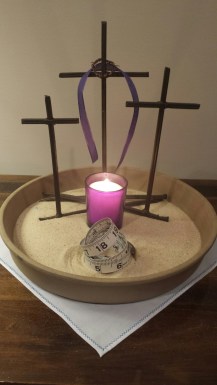
For today, let’s ask God to make us aware of moments when we are apt to critically judge others, and moments when we might overlook our own flaws. Our symbol for today is a tape measure (or ruler), to remind us to be aware of how we are measuring and comparing others with ourselves. Let’s pray that the tape measure will especially remind us to keep from measuring at all!
God loves us all with goodwill. Equally. Totally. Generously. Specks, logs and everything in between.

Benevolent God,
Thank you for your goodwill and love for all of us. Help me to remember that you love us all, totally and infinitely. I don’t need to measure myself with any others to have your love. You love me anyway. Help me to share that same love today. Help me to put down my tape measure and treat everyone with goodwill and kindness. Amen.
Wednesday, March 22nd- Solitude
Matthew 14:23 (NRSV)
23 And after he had dismissed the crowds, he went up the mountain by himself to pray. When evening came, he was there alone…
Our verse for today is one of several that mention Jesus praying alone, away from the crowds and even his disciples. One can imagine Jesus communing with God: turning his full attention to God, resting in God’s love, and listening for God’s guidance before returning to his totally self-giving life. Jesus modeled this practice for us, too, as we seek to love God and follow God’s will with our whole beings.
How might we find time for prayerful solitude in our busy days? Perhaps we need to reconsider our images of solitude and re-imagine what solitude might be. Does our idea of solitude make it seem too difficult? We don’t need to go into the wilderness. We don’t need hours or days alone. We don’t need to be still or silent. We don’t need to sit in a yoga position or even light a candle. Now, these are all great ways to be in solitude! But in our daily living, we can find other ways to spend time in solitude, more comfortably and easily. Solitude with God should be enjoyable.
All we really need is any opportunity to be alone, and a desire to simply spend time loving God.
Aside from journaling, my favorite solitude times are my daily walks. My iPod is playing my favorite songs, and I walk along both busy roads and quiet paths. Even with all of the music, noise, and activity around me, I am centered in God’s presence within me. My mind and heart wander to quiet places where I feel God moving. The silence is the silence of my thoughts more than the quiet of my world. My walks have become treasured times alone with God.
For our Lenten practice of solitude today, let’s consider possible times when we will be alone, but also able to do the things we like to do. Crafting, writing, coloring, fishing, cleaning closets, drinking tea, jogging, hiking… and yes, meditating if this is your practice! Then, let’s plan to use this time to open our hearts to God’s presence. We can enjoy our time, simply and quietly loving and thanking God. It IS possible for us to “Go placidly amid the noise and haste…”(Max Erhmann).
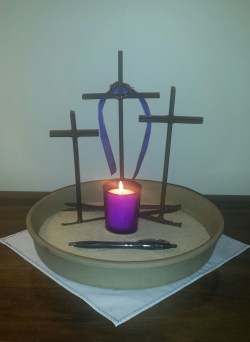
Our symbol for solitude is a pen. The pen brings to mind the practice of journaling, which is an excellent way to be in solitude with God. May the pen also remind us to invite God to write upon our hearts during our time together (Hebrews 8:10).

Our prayer for today is a meaningful way to center ourselves before our solitude time. Read Psalm 46:10, and remove a few words each time. The sentences become significant in their own way. Wherever you are, whatever you do…
Be still and know that I am God.
Be still and know that I am.
Be still and know.
Be still.
Be.
Tuesday, March 21st- Essence
2 Corinthians 2:14-17 (NRSV)
14 But thanks be to God, who in Christ always leads us in triumphal procession, and through us spreads in every place the fragrance that comes from knowing him. 15 For we are the aroma of Christ to God among those who are being saved and among those who are perishing; 16 to the one a fragrance from death to death, to the other a fragrance from life to life. Who is sufficient for these things? 17 For we are not peddlers of God’s word like so many; but in Christ we speak as persons of sincerity, as persons sent from God and standing in his presence.
Our Lenten practice for today is more a way of being than a practice. Our passage reads, “We are the aroma of Christ.” Isn’t this a beautiful description- and a vivid image for us to live by? We are the essence, the fragrance, the gently permeating aroma of Christ!
We can all think of delightful smells that enhance our moments. The evergreen scent of a Christmas tree. The sweet aroma of cookies baking. The clean fragrance of a loved one’s cologne. The woodsy smell of a campfire. The floral scent of my grandmother’s hand cream. The fresh, earthy smell of a rainfall.
Aromas have a gentle, subtle way of influencing and blessing us. Our sense of smell bolsters our taste and sight. A certain fragrance can bring back treasured memories of years past. A lingering scent helps keep warm feelings with us a bit longer.
But there are other aromas, too. When Jim had his open-heart surgery, many people used hand-sanitizing lotions as a precaution against infection. This smell now makes him cringe! The mere scent stirs up memories of his pain and nausea of those days.
If we are the aroma of Christ, how should we smell? What type of fragrance do we want to be? Will we be pleasant, fresh, and delightful? Or offensive and overpowering? Will we foster good feelings or will we make people cringe? How will our essence linger with others? Will our aroma remind people of Christ? Will our scent bless and enhance their experience of Christ?
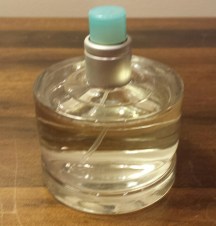
Our symbol is a bottle of cologne. Our essence is the aroma of Christ. May our fragrance gently infuse the atmosphere with love. May our aroma serve to bless people with Christ’s love, enhance their understanding of his presence, and help them to remember him each time they breathe in our lingering scent. Paul says, “In Christ we speak… as persons sent from God and standing in his presence.” Let’s stand in Christ’s presence and allow his essence to surround us today.
Loving God,
May I breathe in Christ’s fragrance and fill with love.
May I stand in Christ’s fragrance and let love surround me.
May I walk with Christ’s fragrance and permeate love in the world.
May I linger as Christ’s fragrance and allow love to remain.
Amen.
Monday, March 20th- Patience

Colossians 1:11-12 (NRSV)
11 May you be made strong with all the strength that comes from his glorious power, and may you be prepared to endure everything with patience, while joyfully 12 giving thanks to the Father, who has enabled you to share in the inheritance of the saints in the light.
My toddler daughter received a gift that many parents dread: a toy drum filled with cymbals, maracas, and a tambourine. As the other parents smiled and chuckled knowingly about the chaos that would ensue, my Aunt Margie wisely told me, “You’ll find the noise won’t annoy you if you join in the parade!” It was true. Aunt Margie knew that the noise only becomes irritating when it interrupts any other intentions of thinking, speaking or listening. I’ve found that her wisdom has stayed with me, long after my children outgrew those noisy toys.
Today our Lenten discipline is patience. Our patience is most tested when life doesn’t go as we plan, isn’t it? The world often pulls us in all directions, not giving us time to handle one issue before another one takes precedent. Something or someone interrupts our thoughts, our goals, our dreams or our expectations, and we become irritated and impatient. And usually the one who receives our impatient response is the innocent one with bad timing.
How might we keep our patience when the noise and the needs are coming from all directions? How might we keep our patience when our own plans are interrupted or delayed?
Let’s imagine we are blissfully (or perhaps, anxiously) driving on the road of life, heading to our desired destination. But up ahead an unexpected parade is passing, and traffic has come to a standstill. We can sit in our car in the middle of the traffic jam, annoyed by the noisy drums, impatient and frustrated by the delay in our plans. But we could also leave our car behind, postpone our destination, and join the parade. It is then we discover that God is moving; God is the One leading this parade of life and wants us to join in. And those who are marching, those who are cheering from the side of the road, and even those who are noisily beating the drums become special blessings in our lives, not the targets of our angry impatience.
Today let’s be ready to join the parade.
Our symbol today is a musical note (or anything you may have to remind you of a noisy parade). May it remind us that our interruptions may become holy interruptions. That our plans may not be God’s plans. That our patience flourishes if we are attentive to the interruption before us, if we see the interruption as an invitation to the parade, and if we joyfully join in the march behind the One who is leading all of us, all the way, with “all of the saints in the light.”

Holy God,
Thank you for your patience with me. Today I ask your help with my patience. Help me to remember that I am not the leader of this parade. Help me to remember that every interruption, every delay, and every detour can be sacred and holy, as long as you are with me. Guide my words and actions, so that others may know of your loving patience through my own. Amen.
Saturday, March 18th- Forgiveness
Mark 11:25 (NRSV)
25 “Whenever you stand praying, forgive, if you have anything against anyone; so that your Father in heaven may also forgive you your trespasses.”
In the past, I have thought this verse meant that forgiveness of others was a condition we needed to fulfill in order to be forgiven ourselves. That God wouldn’t even consider forgiving us unless we forgive others. And so I have wrestled with this passage. As a Lutheran, I have “by grace we have been saved,” firmly ingrained in my mind! Didn’t God powerfully show us that we are loved and forgiven through Jesus- once and for all? That we are forgiven, “not by our own merit?”
But this morning a new understanding came to me:
When we forgive others, the forgiveness we have already been given is more readily received and comprehended by us.
Received…
When we are unable to forgive others, we inwardly doubt that God can forgive us. We stubbornly believe, “I am so angry that I will never forgive this person!” And deep in our thoughts, we worry, “God must be so angry, how could God forgive ME?” Forgiveness is being delivered in huge gift packages to our doorstep, but we won’t open the door to bring them inside. We feel unworthy. But forgiveness has been delivered even as we ARE unworthy (Romans 5:8). We don’t need to forgive others to be forgiven. We need to forgive others in order to open ourselves to receive God’s forgiveness, already so mercifully granted.
Comprehended…
We can never fully comprehend all that Jesus endured to show us how much God loves and forgives us. But when we are able to give the sacrificial, self-giving mercy of forgiveness- even when the forgiven one is unworthy- we might understand how much more Jesus went through for us. Forgiveness is supposed to hurt, so that in some small way we begin to understand what our own forgiveness cost. The more we learn to treat others with loving-kindness and mercy, the more we will appreciate what God is doing for us, with infinite love!
In our Lenten practice of forgiveness today, let’s imagine the gifts of forgiveness waiting on our doorsteps. May we open ourselves to receive these gifts by forgiving others and recognizing our own unworthiness. And as we feel the discomfort of sacrifice and self-giving mercy for others, may we more fully appreciate these precious gifts of forgiveness from God.
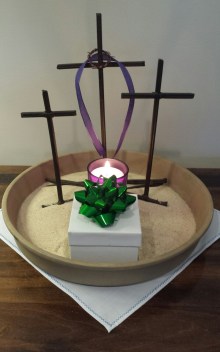
Our symbol is a gift box. God has given us the precious, priceless gift of forgiveness, shown in Jesus’ life, death and resurrection. May we learn to forgive others with mercy and love, and in turn, open our hearts to more fully receive and comprehend this gift of forgiveness ourselves.

Merciful and forgiving God,
I am so unworthy of your forgiveness. Thank you that I humbly know you have forgiven me anyway, as you have shown us through Jesus. Help me to forgive those who have hurt me, as I recognize how much I have hurt you. Change my stubbornness into willingness when it is difficult for me to forgive someone. May I release anything that keeps me from graciously forgiving others, and from experiencing your merciful love and forgiveness for me. Amen.
Friday, March 17th- Comfort

2 Thessalonians 2:16-17 (NRSV)
16 Now may our Lord Jesus Christ himself and God our Father, who loved us and through grace gave us eternal comfort and good hope, 17 comfort your hearts and strengthen them in every good work and word.
Perhaps one of our most difficult callings in life is to be Christ’s loving presence for others during devastating times of grief, illness or loss. The heartbreaking event and its fallout overwhelm us with helplessness. We want to fix. We want to restore. We want to heal. We want to make it all better. We feel uncomfortable with our inability to actually help…
…but we can comfort. This is our Lenten focus for today. To comfort others we need to meet them where they are, with tender listening and presence.
As I reflected on our practice of comforting one another, “Hygge” came to mind. Hygge is a Danish way of living comfortably and simply, of creating coziness in our homes, and of fostering warm relationships with others, especially during long winter months. One definition of hygge is: The art of building sanctuary and community, of inviting closeness and paying attention to what makes us feel open-hearted and alive. (from hygge.co/definition-of-hygge/) I think Hygge may offer exactly what those in need of comfort may need.
I found a few Hygge ideas on the blog, “One Little Happy Thing” (www.onelittlehappything.com):
- Candlelight. When I had a miscarriage, a dear friend kindly lit a candle for me at his morning church mass. This simple act brought great comfort.
- Spend more time in nature. We all benefit from walks in nature’s beauty, soaking up the sunshine. No need for words, just companionship for the journey.
- Make time for loved ones. Time… and presence (and to know when to leave).
- Wear warm comfy clothes. When I was having chemotherapy, I received a warm flannel blanket from dear friends at church. I felt as if I was wrapped in love.
- Soup glorious soup. Bring a pot of soup for someone. Appetites may be small, and the warm broth brings healing and comfort.
- Switch off those screens. Turn off phones and pay attention in order to be truly present.
- Get baking! (No further explanation is needed.)
- Make tea in a teapot. Tea is such a comforting ritual, and there are a variety of wonderful herbal or flavored teas available.
- Watch the sunset. What is it about sunsets that brings a sense of wonder and peace- and mutual silence?
Add to these ideas:
- Pray. Pray for those who are in need of comfort.
- Release our grip. Entrust them to God, who is the “one who loved us and through grace gave us eternal comfort and good hope.”
Oh, how God comforts, and God does so much more than comfort! In the midst of deep despair, we can cling to the hope of God’s redeeming, healing love. There is always a resurrection. In the meantime, we can comfort those who grieve and despair. We can journey with them through the long winter of sorrow, as we look with hope to new life in a glorious spring.
Our reminder symbol is a tea cup. May it remind us to be ready to offer Hygge comfort and God’s comfort to those who need to be tenderly loved.

God, our comfort and hope,
Thank you for the comfort you have given us in difficult times. Thank you for the hope we have in you. Help us to share your infinite love with those who desperately need to feel your love. Help us to know how best to be a comfort and a peaceful presence for them. Amen.

